Is plug-in solar legal in the UK?
Yes, from 27 August 2026, if the kit meets five conditions written into law. Here is the actual wording, what it permits, and the one part of the UK it does not reach.
Rules and product details last checked on .
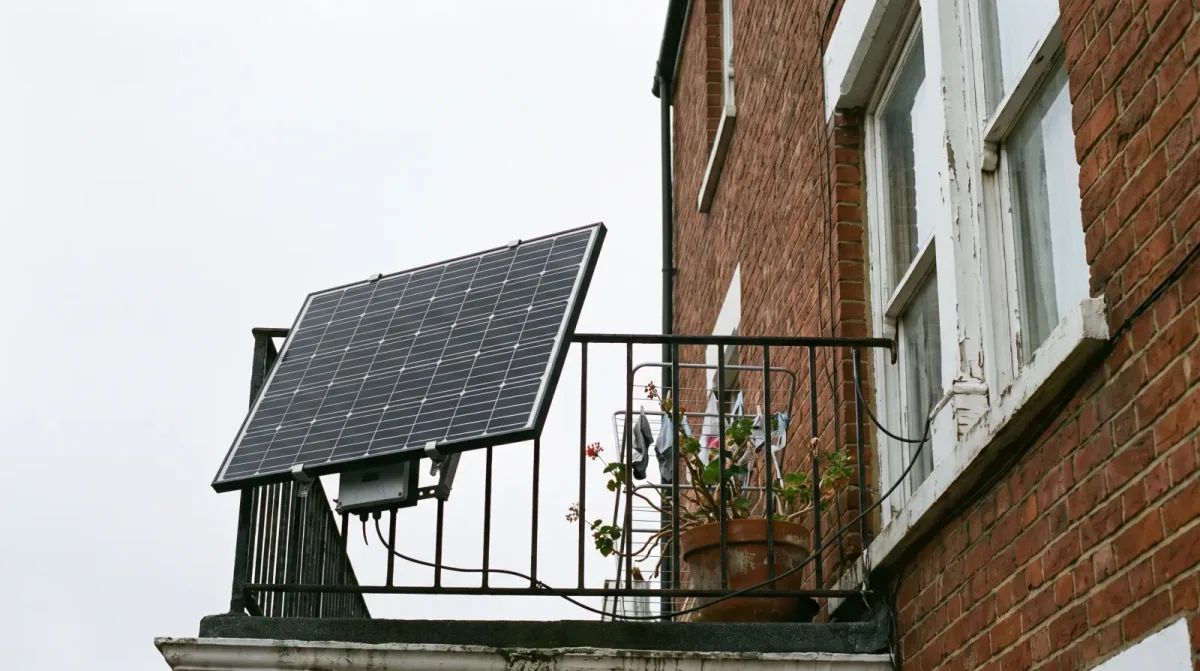
Key takeaways
- Legal from 27 August 2026 in Great Britain, under SI 2026 No. 848.
- Five conditions apply. Sunlight only, 800 W maximum AC output, connected by a standard plug, running in parallel with the grid, and not designed to store electricity drawn from your home.
- A certified complete package is what the law contemplates, not parts assembled at home.
- Northern Ireland is only half covered. The network-side amendment extends to England, Wales and Scotland only.
- This instrument does not cover what you must tell your network operator. That is governed elsewhere.
From 27 August 2026, yes. A statutory instrument made on 16 July 2026 creates a legal category called a plug-in microgenerator and allows it to be connected to a home through an ordinary three-pin socket. Before that date there is no lawful route to plug solar panels into a domestic socket in Great Britain.
The law is SI 2026 No. 848, formally the Plugs and Sockets etc. (Safety) Regulations 1994 and Electricity Safety, Quality and Continuity Regulations 2002 (Amendment) Regulations 2026. Regulation 1(2) sets the commencement date in one line: “These Regulations come into force on 27th August 2026.”
That is the short answer. The rest of this page is what the wording actually allows, because “legal” turns out to mean “legal if it meets five conditions”, and most of the confusion online comes from skipping them.
The five conditions, in the law’s own words
The regulations define a plug-in microgenerator as a source of energy which:
(a) generates electricity from the direct conversion of sunlight into electricity; (b) has a maximum rated alternating current output not exceeding 800 watts; (c) is intended for connection to a low voltage consumer’s installation by means of a standard plug and socket; (d) is designed to operate in parallel with a distributor’s network; and (e) is not designed to import electrical energy from a low voltage consumer’s installation for the purpose of storing energy for later supply, other than for control or auxiliary functions permitted by the Plug-in Solar Device Interim Product Specification.
Translated, each condition rules something out.
Sunlight only. A small wind turbine on a balcony is not covered, however similar it looks as a proposition. The category is photovoltaic and nothing else.
800 watts of AC output, maximum. This is the number that defines the whole category. Note what it measures: the alternating current the inverter sends into your home, not the panels. A kit can carry more panel capacity than 800 W of inverter output, because panels rarely produce their rated figure in British conditions. We unpack what that means for the component itself in our guide to microinverters.
Through a standard plug and socket. This is the part that was previously impossible. The regulations amend the Plugs and Sockets etc. (Safety) Regulations 1994 so that a BS 1363 plug may lawfully be supplied with a microgenerator, even where it departs from BS 1363 in order to make that safe.
Operating in parallel with the network. The kit feeds your home while the grid is still connected. It is not an off-grid or backup device, and it is not designed to keep your lights on in a power cut.
No storing energy drawn from your home. This is the condition most people miss, and it is the one that will disqualify products people expect to be covered. A device designed to pull electricity from your installation to charge a battery for later use falls outside the definition. Limited control and auxiliary functions are allowed, but only as permitted by the Plug-in Solar Device Interim Product Specification. What this means for the batteries actually on sale is its own question, with its own guide.
What this does not mean
It does not mean any panel with a plug on it is now legal. The regulations repeatedly tie approval to the Plug-in Solar Device Interim Product Specification. A kit certified as a complete package against that specification is the thing the law contemplates. Panels, an inverter and a cable bought separately and assembled at home are not the same object in law, even if the parts are individually sound.
It also does not repeal everything else. These regulations amend two specific sets of rules. Anything governed elsewhere, including what you must tell your network operator before connecting, is unaffected by this instrument. We are verifying that separately rather than repeating what other sites assert, and it will get its own guide. Our editorial policy explains how we check this kind of claim before it goes up.
The Energy Saving Trust, an independent body rather than a retailer, has also tracked the change and is a reasonable second reference.
Northern Ireland is not fully covered
This is the detail almost everyone gets wrong, and it is stated plainly in Regulation 1:
(3) Regulations 1 and 2 extend to England and Wales, Scotland and Northern Ireland. (4) Regulation 3 extends to England and Wales and Scotland.
Regulation 3 is the amendment to the Electricity Safety, Quality and Continuity Regulations 2002, which is the half that deals with connecting generation to the distribution network. It stops at the Irish Sea.
So the plug side of the change reaches Northern Ireland; the network side does not. If you are in Northern Ireland, do not assume the 27 August position applies to you in the same way it applies in Great Britain. Check with NIE Networks, the distribution operator there, before buying anything.
Every guide we have read on this subject, including the three sites currently competing for this search, treats the change as UK-wide. It is not, and the distinction is one sentence long in the instrument itself.
What we have verified, and what we have not
We think it matters to be explicit about this, because on a question of legality a confident guess is worse than an honest gap.
Verified against the primary source. The commencement date, the full definition of a plug-in microgenerator including all five conditions, the territorial extent of each regulation, and the fact that approval is tied to the Plug-in Solar Device Interim Product Specification. All of this is quoted above from the instrument as made, published on legislation.gov.uk.
Not yet verified by us. Which specific kits on sale today are certified as complete packages to that specification, and the exact notification you owe your network operator. Both are being checked against primary sources now. When they are confirmed they will appear here with the dates and documents they came from.
What this means if you rent
The practical significance of 27 August is that it removes the legal objection. It does not remove the tenancy question, the leasehold question, or the question of whether it pays where you live and how you use electricity. Those are different problems, and a change in the law does not touch them.
What it does mean is that from that date, a renter in England, Wales or Scotland who buys a certified kit and plugs it in is doing something the law now has a name for. Before 27 August 2026, they were not.
Rules change, and this page carries the date it was last checked. If you spot something that has moved on, tell us and we will verify it against the source and update the date.